English French/Français Home/Accueil Contact
Jean Rioux: émigrant breton, seigneur canadien
The following is an article published by Dr. Benoît Grenier, Professor, Director of the Department of History, University of Sherbrooke, Québec, Canada, entitled "Jean Rioux : émigrant breton, seigneur canadien" in the "Annales de Bretagne et des Pays de l’Ouest", Volume 111, Number 2 (summer 2004), p. 73-88. Used with the permission of Dr. Benoît Grenier.
Jean Rioux:
Breton emigrant, Canadian lord
Benoît Grenier
PhD student in history
University of Rennes 2 Haute-Bretagne – University of Laval, Québec
On March 15, 1696, Jean Rioux and his wife Catherine Leblond exchanged their land of three acres abreast on the St. Lawrence River, on Île d'Orléans, against the land and seigneury of Trois-Pistoles, owned by Mr. Charles Denis from Vitré1. By this transaction, the Breton emigrant Jean Rioux, born in Ploujean, in the bay of Morlaix, in 1652, unable to sign his name, became lord in Canada.
Introduced in New France as early as the 1620s, the seigniorial regime will mark for a century and a half the Laurentian society, but also the territorial organization and the settlement of Canada. In New France, land use was entirely in the seigniorial setting. In 1626, only one lord, Louis Hébert, pioneer of the colony, owner of two lands which have just been erected in fief (land that belonged to a lord), is installed on the heights of what will become the city of Québec. At the time of the conquest of New France by the British, in 1760, about 300 lordships were granted. The British, after some hesitation, will maintain the seigniorial system implanted by the French, but the territories open to colonization after this period will be under English tenure. It was not until 1854 that the Canadian Parliament legally ended the existence of seigniorial tenure.
Jean Rioux's journey from Brittany to Canada in the second half of the 17th century, like 10,000 Frenchmen living in North America, is, from the Canadian point of view, an exemplary illustration of the openness French West on the world in modern times. First modest "habitant2" of the island of Orleans, in the heart of the initial settlement area of Canada, Jean Rioux access, for the least particular singular, the status of lord in a remote area, neither populated nor cleared. In retracing the history of this emigrant from Trégor (city in Britain), through notarial archives, parish and seigniorial Canadian, the opportunity is given to us to recall the importance of the French West in the settlement of New France, but also to evoke the seigniorial reality of the St. Lawrence Valley in a colonizing settlement context. Three parts, corresponding to the various stages of the journey of Jean Rioux, will be discussed: emigration, rooting in New France and seigniorial destiny.
Jean Rioux: Breton emigrant
Jean Rioux (or Roc'hiou) was born in Ploujean, in the bishopric of Tréguier, on March 20, 1652. His father is also Jean and his mother is Marguerite Gueguen. He was baptized on the day of his birth by the rector Claude Gueguen3. Apart from this, we know almost nothing about Jean Rioux's family in Ploujean, except that his paternal grandparents married there in 16184. Departed for New France around 1677, 25 years old, Jean Rioux migrates in a context that is not known to us, but that the study of migration networks between France and New France in the 17th century allows us to imagine. Before discussing his overseas installation, which is much better known to us, let us recall the place occupied by the French West, especially the northwest, in the settlement of New France.
Traditionally, the regions of western France, naturally oriented towards the Atlantic world, were presented by Québec historiography as the place of origin of most immigrants in New France. The last decades have considerably clarified the state of knowledge of migratory movements between the metropolis and its colony in North America, while confirming the predominant place of the West in these migrations. The Research Program in Historical Demography (Programme de recherche en démographie historique; PRDH) at the University of Montréal has conducted a vast study to find out about the population of old Québec (from the origins of the 19th century)5. According to the PRDH database, the founding immigration of the Québec population is estimated at 8,527 immigrants, of French origin at 89.8%6. A very small number compared to the twenty million inhabitants of the kingdom at that time and especially a smaller number in comparison with some 200,000 immigrants from New England, from an England with barely 4 million inhabitants.
Of these, the North-West region is in first place (28.1%), followed by Center-West (26.3%), the Paris Basin (14.3%) and the South-West (10.5%), the other regions of France taking a much more tenuous place. More recently, the American historian Leslie Choquette has resumed the study of migration from a database of 15,810 emigrants, using a more extensive definition of migration, not only retaining the definitive migrants, but also those who were only passing through the colony and could be preserved. The results of its vast study led to the reaffirmation of the preponderance of the West, with 38.6% of migrants from the North-West, 19% from the Center-West and 10.9% from the South-West; the Paris region is relegated to fifth place, behind the East, with less than 10% of migrants7. In both cases, the data relate to French emigration in New France from the origins to the end of the French regime (1760), but whereas the study of the PRDH concerns the St. Lawrence Valley (Canada), that of Leslie Choquette adds Acadie (1,692 migrants out of 15,810)8. Thus, the West, and more particularly the North-West of France (Brittany, Normandy, Perche, Anjou and Maine) retains, in the course of the specialization of studies, a prominent place. In short, from a Canadian point of view, the openness of the West to the world seems obvious.
Within this group, Brittany occupies, according to the data of the PRDH, the sixth rank among the provinces of France for their contribution to the settlement of New France. However, Leslie Choquette's study places the Bretons first, even ahead of the Normans. According to her, Brittany would represent 16.9% of French emigrants in Canada (they would count for only 6% according to the figures of the PRDH)9. This considerable difference may be partly explained by the fact that Leslie Choquette considered seasonal emigrants, but even excluding them, "Brittany's contribution to emigration would remain at 13%, which would still place it at second rank behind Normandy10".
The town of Ploujean, which originated Jean Rioux, is located at the western end of the diocese of Tréguier, east of the bay of Morlaix (current department of Finistère). Still according to the work of Leslie Choquette, the department of Finistere is that of the present Breton departments which has at least furnished emigrants, less open to modernity than western Brittany. Ille-et-Vilaine, because of the importance port of Saint-Malo, would have provided only 6.7% of French emigrants; followed Loire-Atlantique (3%), Côtes-d'Armor (3%) and Finistère (2.2%)11. Overall, we note that the linguistic border between lower and upper Brittany was not unimportant: "More than 60% of the Breton departures to Canada come from the French-speaking part of the province12."
It is therefore from a region of Brittany at first glance less favorable to migration across the Atlantic that Jean Rioux originated. In 17th-century Trégor there is no evidence of migration networks to New France, such as those observed by Gervais Carpin for Perche or Normandy at the same time13. In his study of the notables of Tregor, relating to a later period, Christian Kermoal, however observed migrations towards America, noting certain returns:
"Many are also from Trégor who have made the choice to go abroad, even to return one day in their native parish. Two examples attest to this. The first is only too simple a trace that we owe to the anonymous historian of the old college of Tréguier. In 1782, he reported the presence in the sixth grade of Pascal-François Rolland "of America". It is unfortunate that the author [...] could not learn more about the parish host this character: no element of a possible local career can not be attributed to him. This is not the case of Jean-Baptiste Le Blanc, born in Acadie around 1746-1748. His arrival in France may be the consequence of events affecting Canada from 1755. Still, in 1789, trustee of Guerlesquin, he participated in writing the grievances of his adopted parish14."
In what context and by what means was Jean Rioux linked to New France, we are not allowed to know it, or if there were intermediate stages between his departure from Ploujean and boarding for New France, whose place is not known either. Only one thing is certain, this son of laborer from Trégor is present on the island of Orleans in 1677 and, contrary to the cases evoked by Christian Kermoal, he will never return to his country of origin since a singular destiny awaited him in his host country.
Take root in New France
The first attestation of the presence of Jean Rioux in New France is revealed to us by his marriage contract with Catherine Leblond, on December 26, 1677. He is said then son of plowman, about 21 years old, which rejuvenates him of five years15 [he was 26]. His future wife has just turned thirteen; the wedding will take place on the following January 10 at Île d'Orléans, near Québec16. By the time Jean Rioux migrated to New France, the imbalance between the sexes, a consequence of mainly male immigration, has not yet been restored. The natural increase will allow women to equal men in number around 1700. During the decade of 1670, men are still in surplus in the colony. However, it was common for girls born in the country, of French parents, to marry at a very young age. However, the case of Catherine Leblond, without being exceptional, is below the average age of women in marriage in the 17th century. In the St. Lawrence Valley, generally, in the 17th century, before the stabilization of the marriage market, women married around 19 years and men at 28 years17. In the 18th century, women will marry at 22.2 years and boys at 27 years, closer to the situation prevailing in France at the same time, in the countryside of the Paris Basin, in particular, where men have average 26.6 years and women 24.5 years at first marriage18. In addition to the imbalance of the marital market, the history of the wife's family allows us to make certain assumptions about the young age of the bride.
Catherine Leblond is the eldest of the seven children of Nicolas Leblond, born in Honfleur, and Marguerite Leclerc, from Dieppe. Her parents were married in 1661 in Château-Richer, on the north shore of the St. Lawrence, near Québec City, and settled on the land of Sainte-Famille Parish on Île d'Orléans. Nicolas Leblond dies at the Hôtel-Dieu de Québec in September 1677, about 40 years old. He leaves a widow and seven children aged 10 months to 12 years, the eldest son being just 10 years old19. The death of the father deprives the family of a man who can claim the land. Thus, by contracting marriage with Jean Rioux, about three months after the death of her father, the eldest of the Leblond family, provides the household with a pair of arms as evidenced by this provision of the marriage contract: "The said Riout obliges to serve on his land and dwelling in all reasonable things as a good father, to maintain the household and the land, as they have agreed, in all reasonable things on which the said widow promises to feed him and to maintain him and his wife and children if there are [...] during the said four years [...]20. "At the end of this service, Jean Rioux was to receive a dwelling worth 300 pounds, two oxen aged three years, two cows, a plow and utensils for working the land ... A four-year commitment to the land of the Leblond would give time to the eldest son to reach his 14 years and possibly the widow to remarry.
The contract between the son-in-law and the mother-in-law, however, will not be completed. On land around Leblond, Jean Rabouin also became a widower, probably in the autumn of 1677. Five girls were born from the union of the latter and Marguerite Ardion21. The widow is 39 years old, the widow is 37 years old ... Without knowing the mourning of the events, we can imagine that Jean Rabouin made Marguerite Leclerc a proposal for marriage in the winter of 1677-1678 since, on the 28th February 1678, Jean Rioux and his stepmother, in the study of the notary Paul Vachon22, cancel the contract, at the request of the second who will marry Jean Rabouin six months later23. Jean Rioux is released from his service as a son and, on the same day, leases a land of three acres in the neighboring parish, Saint-François. In the years that follow, Jean Rioux and his wife will rent and buy various lands in Sainte-Famille and Saint-François.
For twenty years, the life of the couple will take place on the l’île d’Orléans where the first seven children of the family are born24. The census of New France of 1681 tells us that Jean Rioux has a land of which 15 arpents [12.67 acres] are highlighted. It is also this census that reveals the birth of their first child, Nicolas, then one year old25. Between the time of their marriage and the birth of their first child, it had been about two years. Catherine Leblond was 15 years old during her first delivery. Two of their children died at a young age, the second son John died just ten days old, while John the Baptist only lived three years. Six children reach adulthood.
A seigniorial destiny
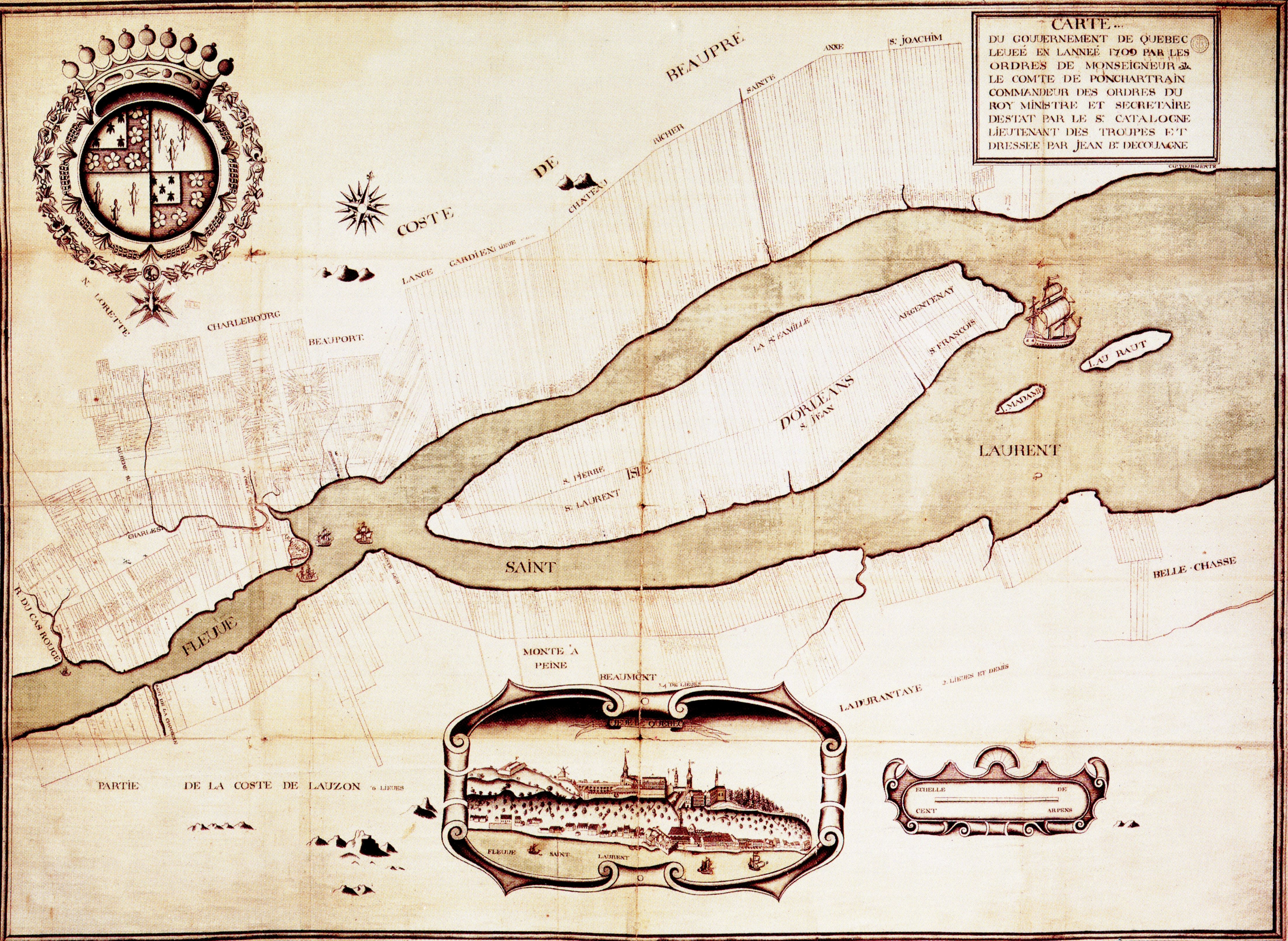
Nothing predestined the emigrant Breton Jean Rioux to become lord in New France. Like other inhabitants of Île d'Orléans, he was more likely to take root and remain there for the rest of his life. However, about twenty years after settling there, it is again a destiny of pioneer and migrant who awaits it, but this time a pioneer of dignity seigneuriale! Before the notary Chambalon, on March 15, 1696, Jean Rioux makes an exchange with consequences for him and his family. Against his land of three arpents [1.53 acres] front, located in Saint-François, he
Map of the Government of Québec by Gideon of Catalonia, 1709
(Lessard, Michel, L’île d’Orléans. Aux sources du peuple québécois et
de l’Amérique française [Sources of the Québec People and
French America], Montréal, Éditions de l'Homme [Editions of the Man], 1998,
page 142)
acquires from Sieur de Vitré a seigniory with a front two leagues [6 miles] on the St. Lawrence: Trois-Pistoles. In addition to his land, his house, his barn and his stable, Jean Rioux leaves two oxen, two cows, six chickens, a rooster and some pigs in this transaction. In addition, he commits himself to promote for a year the land he exchanges, which is why he receives 20 bushels of wheat and 20 pounds for the two cows26. But here he is, become lord!
At a time when the river is the only road connecting the various settlement areas, the seigneury of Trois-Pistoles, granted to Charles Denys de Vitré in 1687, is located on the extreme outskirts of the colonial capital, Québec. Also, it is not surprising that his first lord, noble and resident of Québec, probably never set foot there. The possession of this lordship, far from Québec and not cleared (in "standing timber"), was for him of no value, to such a point that a simple parcel of cleared land on l’île d’Orléanss, an area already becoming saturated, seemed more interesting to him.
At the end of his commitment to the Sieur de Vitré, Jean Rioux is preparing to leave the Île d'Orléans to take possession of his seigneurie. Before leaving, he discards the property he still owned at this location. On March 14, 1497, he sold a land of St. Francis to Gabrielle Denis27, and on the same day he divested himself of another parcel of cleared land of the same size, located at Sainte-Famille, in favor of Pierre Martineau28. For the first, he gets 600 pounds and 695 for the second. Finally, still on March 14, he sold to his brother-in-law, Jean Leblond, the share of land that had fallen to his wife by succession of his father; he gets 450 pounds29. Before leaving the region of Québec, where he may not return, Jean Rioux fulfills his new feudal obligations by giving faith and homage to the king, of which he is the vassal (feudal tenant).
In New France, the act of faith and homage is usually performed at the Château Saint-Louis, located on the Cap Diamant in the upper city of Québec and residence of governors, representatives of the king in the colony30. However, on April 10, 1697, Jean Rioux surrendered, not to the castle Saint-Louis, but to the palace of the administrator, by a special dispensation of which we do not know the motivation. It is before the intendant Bochart de Champigny, that the new lord is executed: "Habitant31 residing on the island of St-Laurent [...] vassal of the King our Sire, to whom he returned in our hands the faith and homage that he is obliged to make and wear [...]." At the end of this act, Jean Rioux says he does not know how to sign32.
These cases settled, the Rioux family is ready for departure. It is in all likelihood, in June 1697, after the river was free of ice, that the couple and their children settled in their lordship of Trois-Pistoles. In a boat, a biscayenne rowboat ceded by the Sieur de Vitré33, they undertake a journey of about 250 kilometers [155.34 miles] on a river
Location map
(Courville, Serge [dir.], Population et territoire [Population
and Territory],
Sainte-Foy, Presses of University of Laval, coll. "Atlas historique
du Québec [Historical Atlas of Québec]", 1996, page 48)
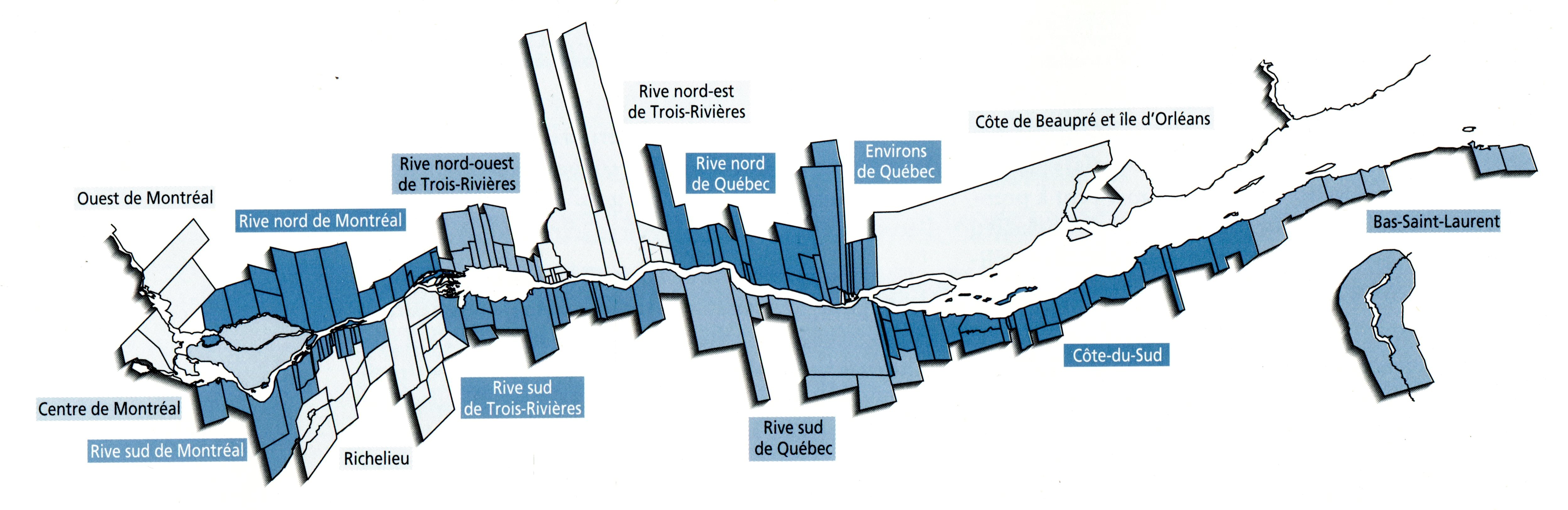
which, from the tip of l’île d’Orléans to the Gulf of St. Lawrence, continues to expand. At the height of Trois-Pistoles, the other bank is no longer visible. Jean Rioux was then 45, his wife Catherine Leblond, 33 years old. Their eldest sons, Nicolas and Jean, are 15 and 13 years old, while the younger, Pierre, is not three years old34. In addition to being the first sedentary lords of Trois-Pistoles, they were also the first settlers.
If the nobility does not constitute more than in France a necessity to acquire a seigniorial title, the presence of small commoners as modest among the seigneurial group can astonish. In the colony, the social rise affects a large number of individuals and the accession to the seigneurial property constitutes one of the most convincing demonstrations. In a previous study, we identified, for the Québec government alone, 62 small commoners, mostly peasants, who became lords in New France. In general, these individuals gained seigneurial property by their merit, as a reward for a career or pioneer status, by family relationships, or even by their economic success35. The case of Jean Rioux appears to this effect quite unusual. It is not unique, however.
The Lower Saint Lawrence region did not count as the Rioux as lords of modest origin. In the seigniories of L'Isle-Verte and Rimouski, not far from there, the lords Côté and Lepage also obtain their lordship in exchange for land on l’île d’Orléans. At the moment when the Rioux became lords of Trois-Pistoles, the family of Rene Lepage had already acquired, in the same way, in 1694, the seigniory of Rimouski, even more distant than that of Trois-Pistoles36. In the case of the Lepage, it is the Sieur Augustin Rouer de la Cardonniere who had exchanged his lordship, just as wooded as that of the Rioux. There is no doubt that this precedent incited, a few years later, the Sieur de Vitré to do the same. The third example, that of Jean-Baptiste Côté, also inhabitant of l’île d’Orléans, who trades his land with the lordship of L'Isle-Verte (neighbor of Trois-Pistoles), occurs later, only in 1711, but the social situation of both parties is similar to the other two37. These three families settle in this undeveloped region without delay and, for several generations, Rioux, Lepage and Côté see their children marry each other. Take care to see a form of homogamy seigniorial, since these three families are also the only human beings for miles around...
The life of the Rioux, from their installation in their lordship of Trois-Pistoles, is poorly documented. Only on the spot, Jean Rioux and his family have little opportunity to contract notarized deeds and parish life is non-existent, only a few missionaries occasionally come to these confines of inhabited Laurentian territory. It was not until the 19th century before seeing a notary and a resident priest. This isolation will even contribute to the birth of certain local legends that are now part of Québec's folk heritage, notably the silver goblet of Lord Rioux. According to this Pistols legend, a missionary priest to whom lord Rioux had offered a silver goblet and who died drowned when he returned from Trois-Pistoles to Québec, brought back in the lord's house the famous goblet, the only object of "luxury" of the Rioux, who had sunk with him38.
The eighth and last child of Jean Rioux and Catherine Leblond was born in Trois-Pistoles, probably in 1698, but no act of baptism was found. This is Marie-Madeleine Rioux who will be a nun at the Hospitalières de l'Hôtel-Dieu de Québec39.
The installation of a lord on his land in the St. Lawrence Valley usually coincides with an expansion of settlement and territorial development. The decision to reside is usually accompanied by a clear desire to establish censitaires (one who pays rent to his feudal lord) on seigneury, which are, in fact, in principle, the lords. Promulgated in 1711, the Judgement of Marly reminded lords of their obligation to develop their seigniorial domain. Although these judgments do not oblige the lords to reside, they testify to the problem of seigniorial absenteeism40. If the lords do not develop their properties, it is obvious that residing there is probably not a possibility in their eyes. This state intervention, which targets both lords and censuses, forcing them to clear the land granted, threatens to deprive the individuals concerned of their title deeds if they have not remedied the situation in the year that follows. As the lords are omnipresent in the colonial administration, the Judgement of Marly remain without a future; "In 1719, nothing concrete has yet been done, Governor Vaudreuil and Bursar Bégon claiming that the intention was only to pose a threat and arouse fear41."
However, in Trois-Pistoles, despite the presence of the Rioux family, there is a slow development of seigneury and, in the first phase, relatively long, the absence of census concessions. During the first two decades, the Rioux family seems to be the only one to reside on the spot, as evidenced by the first confession and enumeration of the lordship, made in 1723 by the son of Jean Rioux, Nicolas. Indeed, twenty-six years after the arrival of the Rioux at Trois-Pistoles, they are still the only inhabitants, like their "neighbors" the lords Côté at L'Isle-Verte42. It may be supposed that the lords Rioux had no doubt in attracting censitaires, or that they were content to clear their land without wanting to install other people than their children. Nevertheless, given the isolation and the desire for security linked to a human presence, it seems rather unlikely that the absence of censitaires resulted from a choice. Quite simply, the settlement had not yet reached Trois-Pistoles, which no road other than the river connected to Québec; it will not reach this remote region of the St. Lawrence Valley until the second quarter of the 18th century. Knowing that it was not until 1737 that an earthly road, the royal road, would connect Québec and Montréal, the seigneury of Trois-Pistoles had to wait a century after the arrival of the Rioux before seeing its visitors arrive otherwise than by boats43.
In addition to the birth of a last child and evidence of hard work related to the exploitation of forest land and the rigors of winter, we do not know the last years of the life of lord Jean Rioux. One can nevertheless imagine a standard of living, obviously, of the first necessity, like the first settlers of other Canadian seigneuries. The first house was certainly a wooden cabin in pieces on pieces, built in the abundant forest that then constituted Trois-Pistoles and comprising only one room. Settlers usually later extended these settlement houses or built "real" houses, but always made of wood, with the exception of areas where stone abounds, such as Beauport, where quarries of limestone were used as early as the 17th century44. It is obvious that the conditions of life that the Rioux lived in Trois-Pistoles, at least during the first years, were rudimentary in comparison with what they must have known on l’île d’Orléans, already achieved, all proportions kept at a certain level of "comfort". Generally, it is estimated that "it takes ten or eleven years to have a dozen acres in plows, the minimum to be able to put his land in ground (land that is not farmed; it changes every year so that lands could be renewed) when there is a family to feed"45. After about thirty years, the average concession represents 30 arpents [25.34 acres] of farmed land, the time of a generation spent clearing and building46.
Jean Rioux probably never saw his lands reach such a level of development. Although we do not know the date of his death, we know that he was no longer living at the time of the marriage of his eldest son, Nicolas, August 13, 171047, thirteen years after the installation of the family in Trois -Pistoles. Nothing allows us to know if he lived long after 1697. Other members of the Rioux family died on an unknown date, after their installation in Trois-Pistoles: Jean, born in 1684, and Catherine, born in 1693, who are no longer listed in 1723 at the time of confession and enumeration48.
On the death of her husband, the seigneuress Catherine Leblond is left with at least four living children: Nicolas, Vincent, Pierre and Marie-Madeleine. Seniors are probably old enough to take over from their father. Nicolas becomes the main lord and his brothers and sisters co-lords. The new lord took his wife to l’île d’Orléans in 1710, uniting his life with that of Louise Asselin, whom he had undoubtedly known before the family moved to Trois-Pistoles. His brother Vincent married, in 1731, Catherine Côté, daughter of the lord of L'Isle-Verte, neighboring seigneury49. Pierre remained single and the youngest became a nun. Thus, two lineages of Rioux were born in Trois-Pistoles, which can claim all the Rioux, very numerous today in America and still very present in the area of Trois-Pistoles and Bas-Saint-Laurent in general.
The seigneuress lived very long, in the company of her children, grandchildren and great-grandchildren. In spite of the autonomy and authority conferred upon her by the custom of Paris50, Catherine Leblond, like other seigneurs, abandoned the control of the destiny of the seigneury to her son Nicolas, who alone land grants in the seigneurie, without mention being made of the title of his mother, Catherine Leblond. She died on December 1, 1753, at the age of 89 and two months. His act of burial bears the following mention: "owner and seigneuress of Trois-Pistoles"; is it the respect due to his great age that will have earned him finally qualified as seignioress? Previously, she had always been called "widow of the lord" and never seignioress. It must be said that her husband had passed away for 48 years and that her memory was certainly beginning to fade ... Catherine Leblond is buried in the church of Trois-Pistoles53.
Six generations of Rioux lords succeed each other at Trois-Pistoles between 1697 and 1854, the year of the abolition of the seigneurial regime: Jean (1697-1710), Nicolas (1710-1756), Étienne père (1756-1784), Étienne fils ( 1784-1805), Joseph (1805-1829) and Eloi (1829-1854). The Rioux family, with its constant presence in the seigneury of Trois-Pistoles and its preservation of the seigneurial title over nearly two centuries, represents an exceptional case among the lords of the St. Lawrence Valley. On the one hand, resident lords have always been a minority among all Laurentian lords (throughout the 18th century, the resident lords account for about 30% of the lords, they will be a maximum of 40% at the time of the abolition of the seigneurial regime). On the other hand, seigneuries that belonged to the same family for such a long time are extremely rare. With the Juchereau-Duchesnay in Beauport or Boucher Boucherville, the Rioux of Trois-Pistoles are among the few original noble families still in place in the mid-19th century.
Coming from Brittany to Canada, at the end of the period of immigration founder, Jean Rioux knew a course not only unique, but still remarkable. If the accession of small commoners to seigneurial property in New France is a very real phenomenon, the process of social elevation is not always so fast. Lord in Canada, certainly, but Jean Rioux, in the eyes of his French contemporaries, would doubtless have seemed a very peculiar lord. Of humble origin, illiterate, clearing land, lord without censitaires ..., Jean Rioux and his family probably had a life similar to the other pioneers of New France. Although lords, the living conditions of these pioneers of the lower St. Lawrence were no easier than those of the censitaires in the other seigneuries. Even for lords, social life was obviously limited in the region of Trois-Pistoles at the turn of the eighteenth century! They were certainly more connected to the rural population of their lordship than to the colonial elite. Nevertheless, despite the absence of a strong affirmation of their seigniorial status, over the decades and centuries, at the discretion of the settlement of the lordship, the Rioux came to distinguish themselves from their census. Although most of the descendants of the lords Rioux no longer bear the mark of the notability associated with the status of lord of their ancestors, the memory remains present. But what memory? That of ancestors colonizers of Trois-Pistoles or rather ancestors lords? Probably both because they are inseparable, as evidenced by the celebrations of the 300th anniversary of the arrival of the Rioux at Trois-Pistoles, celebrated in 1997, during which we commemorate the memory of Jean Rioux and Catherine Leblond on the occasion of a gathering of the Rioux of America. On the side of the former censitaires too, the memory remains. In the second half of the 20th century, the descendant of the last lord of Trois-Pistoles continued to be designated by the inhabitants of the place as "the seignioress" and this, although, officially, the seigneurial regime was no longer for more a century.
Bibliography
Carpin, Gervais, Le réseau du Canada. Étude du mode migratoire de la France vers la Nouvelle-France (1628-1662) [Canada's network. Study of the migration mode from France to New France], Paris/Sillery, Presses de l’Université de Paris-Sorbonne/Septentrion, 2001, 555 pages
Choquette, Leslie, De Français à paysans. Modernité et tradition dans le peuplement du Canada français [From French to peasants. Modernity and tradition in the settlement of French Canada]. Paris/Sillery, Presses de l’Université de Paris- Sorbonne/Septentrion, 2001, 325 pages
Dépatie, Sylvie, Lalancette, Mario et Dessureault Christian, Contributions à l’étude du régime seigneurial canadien [Contributions to the study of the Canadian seigneurial regime], Montréal, Hurtubise, 1987, 292 pages
Harris, Richard Colebrook, The Seigneurial System in Early Canada. A Geographical Study, Kingston/Montréal, McGill/Queen’s University Press, 1984 (1966), 247 pages
Jetté, René (dir.), Dictionnaire généalogique des familles du Québec. Des origines à 1730 [Genealogy Dictionary of Québec Families. From origins to 1730], Montréal, Programme de recherche en démographie historique (PRDH), 1983, 1177 pages
Kermoal, Christian, Les Notables du Trégor. Éveil à la culture politique et évolution dans les paroisses rurales (1770-1850) [The Notables of Trégor. Awakening to political culture and evolution in rural parishes], Rennes, Presses universitaires de Rennes, 2002, 488 pages
Laberge, Alain, «Propriété et développement des seigneuries du Bas Saint-Laurent, 1670-1790 [Ownership and development of the seigneuries of Bas Saint-Laurent]», in Mathieu, Jacques et Courville, Serge (dir.), Peuplement colonisateur aux XVIIe et XVIIIe siècle [Settler population in the 17th and 18th centuries], 1987, pages 203-247.
Langlois,Michel, «Jean Rioux», dans Dictionnaire biographique des ancêtres québécois (1608-1700) [in Dictionary of Québec Ancestors], volume 4, Sillery, Mitan, 2001, pages 254-255.
Mathieu, Jacques, La Nouvelle-France. Les Français en Amérique du Nord XVIe-XVIIIe siècle [New France. The French in North America 16th-18th century], Paris/Sainte-Foy, Belin/Presses de l’Université Laval, 1991, 254 pages
Morissette, Jacques, «Jean Riou et Catherine Leblond [Jean Riou and Catherine Leblond]», L’écho des Basques [Echo of Basques], Société historique et généalogique de Trois-Pistoles [Historical and Genealogical Society of Trois-Pistoles], number 16, pages 44-47 and number 17, pages 42-51.
Ouellet, Fernand, «Propriété seigneuriale et groupes sociaux dans la vallée du Saint-Laurent (1663-1840) [Seigneurial property and social groups in the St. Lawrence Valley]», Revue de l’Université d’Ottawa [University of Ottawa Journal], volume 47, number 1, 1977, pages 183-213.
Rioux, Emmanuel (dir.), Histoire de Trois-Pistoles 1697-1997 [Histoiry of Trois-Pistoles], Trois-Pistoles, Centre d’édition des Basques/Société historique et généalogique de Trois-Pistoles [Basque Publishing Center/Historical and Genealogical Society of Trois-Pistoles], 1997, 703 pages
Trudel,Marcel, Les débuts du régime seigneurial canadien [The beginnings of the Canadian seigneurial regime], Montréal, Fides, 1974, 313 pages
ABSTRACT
At the end of the 17th century, Jean Rioux, peasant native of Ploujean in Morlaix’s bay, becomes “seigneur” [lord] of Trois-Pistoles in the Saint-Lawrence Valley, Canada. The singular fate of this emigrant from Trégor in New France constitutes, on an individual and familial scale, an exemplary illustration of western France opening on the world in the modern times. The main stages of Jean Rioux’s life: the emigration, the implanting in Canada and the seigneurial fate, discussed in the present article, lead us from Finistère (Britanny) to the isolated region that was “Bas-Saint-Laurent” in the turn of the 18th century. But especially, the life of this Breton emigrant provides a wider glance to the history of the French colonization of Canada and on the western France place in this one, as well as on the territorial and social organization of this new society in which the seigneurial system plays a central role.
Footnotes